WhatsApp Business API pricing is per delivered message: Meta charges by message category (marketing, utility, authentication, service) and by the customer's country code. Since October 1, 2026, your replies are billed too, once a phone number has used its 1,000 free service messages for the month.
In the US that means $0.025 per marketing template and $0.0034 per utility, authentication or service message; in the UK, $0.0635 and $0.022. On top of Meta's fees you pay whatever your platform charges. This guide has the current rates for five markets, what changed in October, worked monthly costs at three volumes, and how Meta's own AI agent is priced.
Updated November 16, 2026. All rates are Meta's USD list rates effective October 1, 2026, taken from the rate card on Meta's WhatsApp pricing page and checked on 2026-11-16. Meta can change rates on the first day of each quarter, so check the rate card before you budget.
How we made this page: every Meta rule and rate below comes from Meta's developer documentation and its downloadable rate card; platform fees come from each vendor's own pricing page, with the date we checked. It was drafted with AI assistance under our editorial policy. Disclosure: Asks connects to the WhatsApp Business Platform as a messaging channel. Meta bills your WhatsApp Business account directly for the messages it delivers; Asks doesn't resell or mark up Meta's fees.
Also available in Spanish (with Latin American rates) and Portuguese (with the Brazil rate table in reais).
What changed on October 1, 2026
Four changes landed in 2026. Two of them took effect on October 1:
- Service messages are charged again. A service message is any free-form reply (text, image, document, buttons) you send inside the 24-hour customer service window that a customer's message opens. Meta hadn't charged for them since November 1, 2024. Now each business phone number gets 1,000 free delivered service messages per month, and Meta charges from the 1,001st at the service rate for the customer's country. Unused messages don't roll over; the count resets at midnight in your Messaging account's time zone.
- Utility templates sent inside the window are charged. An order confirmation or shipping update sent while the customer's window is open had been free since July 1, 2025. Since October 1, 2026 it's billed like any other utility template.
- No payment method, no service messages past the allowance. Meta told businesses to add a payment method by September 30, 2026. Without one, Meta still delivers service messages inside the free tier, but stops delivering them once the 1,000 are used.
- Meta's own AI agent got its own category. Meta Business Agent, Meta's AI that answers customers for a business, launched on July 1, 2026 and has been charged per token since August 1, 2026 (details below).
Meta also updated 40 rates on October 1 and moved nine markets out of "Rest of" regions onto their own rates. The billing model itself didn't change: Meta switched from per-conversation pricing to per-message pricing on July 1, 2025, and still charges only for messages that are delivered, never for the messages customers send you.
The five message categories
Every message your business sends falls into exactly one category and incurs at most one charge. The rate depends on the category and on the recipient's country calling code, not on where your business is.
| Category | What it's for | When you can send it | How Meta charges |
|---|---|---|---|
| Marketing (template) | Promotions, launches, abandoned-cart nudges | Any time, to opted-in customers | Per delivered message; the most expensive category |
| Utility (template) | Order confirmations, shipping and account updates | Any time | Per delivered message, with volume tiers |
| Authentication (template) | One-time passcodes | Any time | Per delivered message, with volume tiers; some markets have a higher authentication-international rate |
| Service (non-template) | Free-form replies from a person or a third-party AI | Only inside the 24-hour customer service window | Per delivered message after 1,000 a month per number; no volume tiers |
| Meta Business Agent (non-template) | Replies written by Meta's own AI agent | Only inside the 24-hour window | $2.00 per 1 million tokens, covering the AI and the delivery |
Templates are pre-written messages Meta reviews before you can use them, and the category you choose largely decides the price. Here is what that choice looks like in Asks, where the template editor sends your category and sample values to Meta for review:
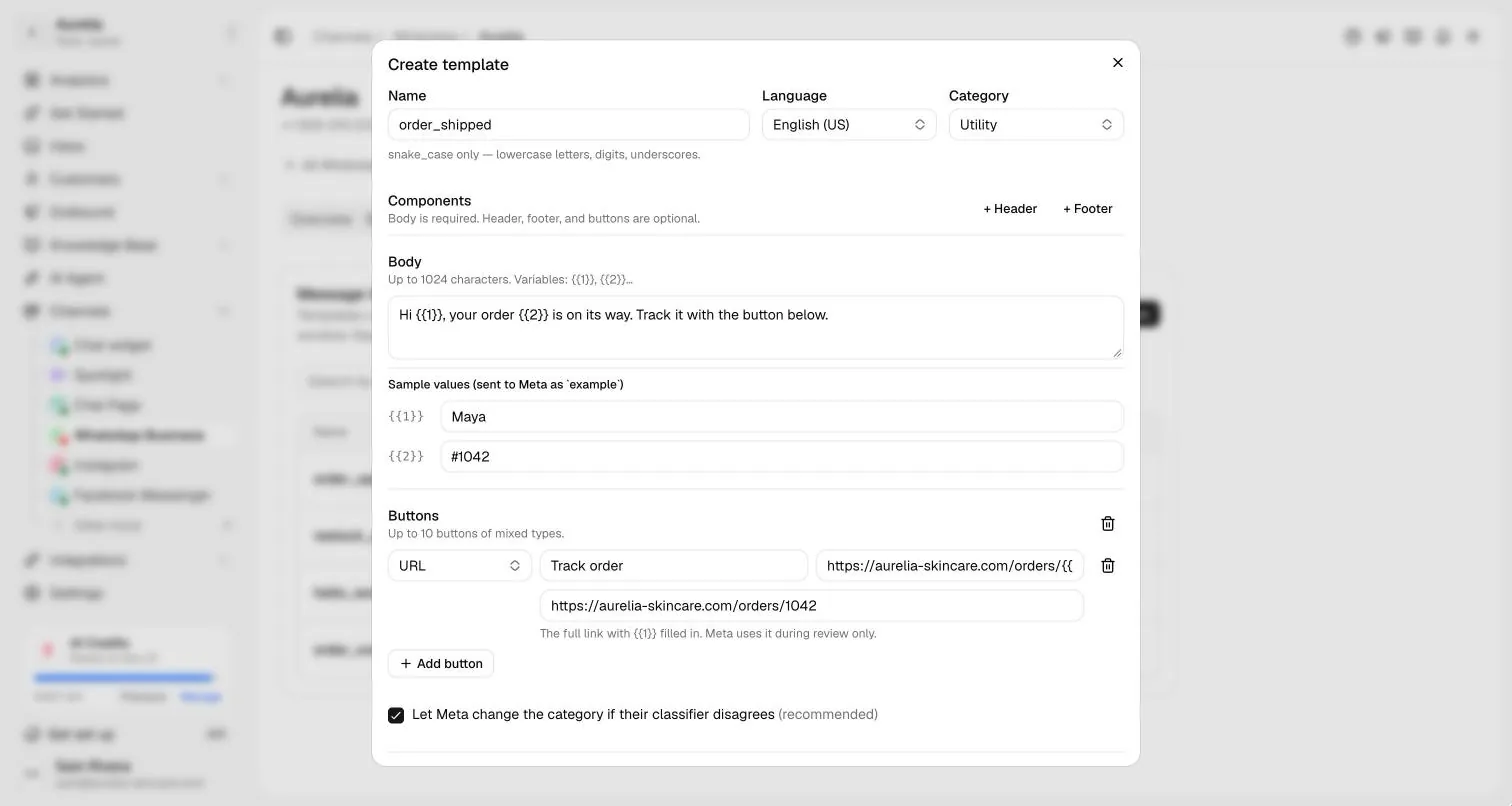
Meta's classifier can override a wrong category. A "utility" template that is really a promotion will be reclassified as marketing or rejected, so labelling everything utility doesn't save money for long.
Current rates for the US, UK, India, Brazil and Indonesia
USD list rates per delivered message, effective October 1, 2026, from Meta's rate card:
| Customer's market | Marketing | Utility | Authentication | Service (after 1,000 free a month) |
|---|---|---|---|---|
| United States and Canada ("North America") | $0.025 | $0.0034 | $0.0034 | $0.0034 |
| United Kingdom | $0.0635 | $0.022 | $0.022 | $0.022 |
| India | $0.0118 | $0.0014 | $0.0014 | $0.0014 |
| Brazil | $0.0625 | $0.0068 | $0.0068 | $0.0068 |
| Indonesia | $0.0411 | $0.025 | $0.025 | $0.025 |
For context, the same rate card lists Germany at $0.1365 for marketing and $0.055 for the other three categories, and Mexico at $0.0397 and $0.0085. Countries Meta doesn't name are billed at a regional rate such as "Rest of Asia Pacific" or "Other".
Four details change real bills:
- Service rates equal utility and authentication rates in every market. Meta set it up that way and doesn't offer volume tiers on service messages.
- Utility and authentication have volume tiers. Past certain monthly volumes per market, Meta charges a lower tier rate, aggregated across your business portfolio. The examples below use list rates, so treat them as a ceiling.
- Authentication-international rates apply to large senders (Meta's threshold is more than 750,000 messages outside service windows in 30 days) that send passcodes to users in certain markets from a business based in another country. India's is $0.0304 and Indonesia's $0.136 per message, many times the domestic rate.
- You can be billed in local currency. Meta has 16 billing currencies. Messaging accounts billed from Brazil must move to reais by June 30, 2027, and those billed from India to rupees by December 31, 2026.
What Meta doesn't charge for
- Messages customers send you. Inbound messages never cost anything.
- The first 1,000 service messages each month, per business phone number. The allowance belongs to each number, so a business running three numbers gets three allowances.
- The free entry point window. When someone messages you from a Click to WhatsApp ad on Android or iOS and you answer within the customer service window, Meta opens a window of up to 7 days in which marketing, utility, authentication and service messages aren't charged. Meta Business Agent messages are still charged in it.
Worked examples at three volumes
Here is what Meta alone would bill one business phone number in a month, at list rates. Each scenario assumes about three replies per customer conversation, plus transactional and promotional templates:
- Small: 1,500 service messages (about 500 conversations), 500 utility templates, 1,000 marketing templates.
- Growing: 6,000 service messages (about 2,000 conversations), 2,000 utility templates, 5,000 marketing templates.
- High volume: 30,000 service messages (about 10,000 conversations), 10,000 utility templates, 25,000 marketing templates.
The service column subtracts the 1,000 free messages first.
Small (1,500 service, 500 utility, 1,000 marketing)
| Market | Service | Utility | Marketing | Meta total |
|---|---|---|---|---|
| United States | $1.70 | $1.70 | $25.00 | $28.40 |
| United Kingdom | $11.00 | $11.00 | $63.50 | $85.50 |
| India | $0.70 | $0.70 | $11.80 | $13.20 |
| Brazil | $3.40 | $3.40 | $62.50 | $69.30 |
| Indonesia | $12.50 | $12.50 | $41.10 | $66.10 |
Growing (6,000 service, 2,000 utility, 5,000 marketing)
| Market | Service | Utility | Marketing | Meta total |
|---|---|---|---|---|
| United States | $17.00 | $6.80 | $125.00 | $148.80 |
| United Kingdom | $110.00 | $44.00 | $317.50 | $471.50 |
| India | $7.00 | $2.80 | $59.00 | $68.80 |
| Brazil | $34.00 | $13.60 | $312.50 | $360.10 |
| Indonesia | $125.00 | $50.00 | $205.50 | $380.50 |
High volume (30,000 service, 10,000 utility, 25,000 marketing)
| Market | Service | Utility | Marketing | Meta total |
|---|---|---|---|---|
| United States | $98.60 | $34.00 | $625.00 | $757.60 |
| United Kingdom | $638.00 | $220.00 | $1,587.50 | $2,445.50 |
| India | $40.60 | $14.00 | $295.00 | $349.60 |
| Brazil | $197.20 | $68.00 | $1,562.50 | $1,827.70 |
| Indonesia | $725.00 | $250.00 | $1,027.50 | $2,002.50 |
What the numbers say:
- Marketing is most of the bill almost everywhere. In the US, Brazil and India, promotional templates are 80% or more of the total. The October change matters, but cutting one weak campaign usually saves more than anything you do to support traffic.
- Support got expensive in the UK and Indonesia. At $0.022 and $0.025 per message, support traffic (service plus utility) for the growing scenario costs $154 and $175 a month in Meta fees alone, against $23.80 in the US. If you serve those markets, the number of messages per resolved question now has a price.
- The allowance protects small senders. A number that sends fewer than 1,000 replies a month pays nothing for service messages. Splitting traffic across numbers multiplies the allowance, though most businesses won't want to run separate numbers just for that.
- Volume tiers bend the high-volume rows down for utility and authentication. Check the volume tier file next to Meta's rate card for your markets.
To estimate your own bill, count last month's messages by category and multiply by your customers' country rates. The formula is (service messages − 1,000) × service rate + utility × utility rate + marketing × marketing rate + authentication × authentication rate.
Meta Business Agent: priced per token, not per message
Meta Business Agent is the one category that isn't a flat per-message rate. Meta charges one global rate of $2.00 per 1 million tokens, counting input and output tokens but not cache tokens, and that single charge covers both the AI processing and the delivery. Meta's documentation says a message typically uses 20,000 to 25,000 tokens, about 4 to 5 cents per message. Its own examples: a simple question answered in four messages costs about 16 to 20 cents; a complex one answered in ten messages costs about 40 to 50 cents. Volume tiers and the free allowances don't apply, and the free entry point window doesn't cover it.
For scale, the 6,000 replies in the growing scenario would cost roughly $240 to $300 a month through Meta Business Agent, wherever your customers are. Sent as service messages, the same replies cost Meta $17 in the US or $125 in Indonesia, plus whatever your AI provider or your team costs. Meta itself warns that this isn't an apples-to-apples comparison, because service messages need people or a third-party AI behind them; its pricing page estimates third-party AI at roughly 2 to 9 cents per message before delivery.
Whether Meta's agent is the cheaper route depends on how many messages it takes to resolve a question and on what the alternative costs you. We compare the two in detail in Meta Business AI vs a dedicated AI agent.
A separate rule covers "AI Providers": companies whose product is a general-purpose AI assistant on WhatsApp. Meta charges them per service message in Brazil (since March 11, 2026) under its AI Providers pricing, and its page states the policy doesn't change what other businesses pay. A store or clinic using AI to answer questions about its own products is the ordinary case; our WhatsApp AI chatbot guide covers where that line sits.
What a platform adds on top of Meta's fees
Most businesses reach the API through a Business Solution Provider (BSP) or a support platform built on one. That second layer is priced in one of four ways:
- A per-message markup. Twilio, for example, adds $0.005 per WhatsApp message, inbound or outbound, plus $0.001 for each failed message, on top of Meta's fees (Twilio WhatsApp pricing, which says "pricing current as of September 2026"; checked 2026-11-16). A markup on inbound messages means you also pay for messages customers send you, which Meta itself never charges for.
- A flat fee per number. 360dialog charges from €49 a month per number on its Regular plan and states it adds no markup to Meta's fees (360dialog pricing, checked 2026-11-16).
- Per contact or per seat. Many inbox and marketing platforms price by active contacts or by teammate. Your bill grows with your list or your team, whatever your message volume.
- Per AI resolution. Some AI support tools bill each conversation the AI resolves, which charges you more as automation works better.
The comparison that matters is Meta's fees for your message mix + the platform's fee at your volume. A low monthly price with a per-message markup can cost more than a flat plan once volume grows, and per-contact pricing punishes a big list that rarely writes in.
Where Asks fits
Asks connects your WhatsApp number through Meta's Embedded Signup, either a new number on the Cloud API or the number you already use in the WhatsApp Business app (coexistence mode). Meta bills your WhatsApp Business account directly at the rates above; Asks doesn't add a per-message markup. Asks plans are flat monthly prices with AI credits included (500, 4,000 or 10,000 a month depending on the plan), with no per-resolution or per-contact fees; current prices are on the pricing page.
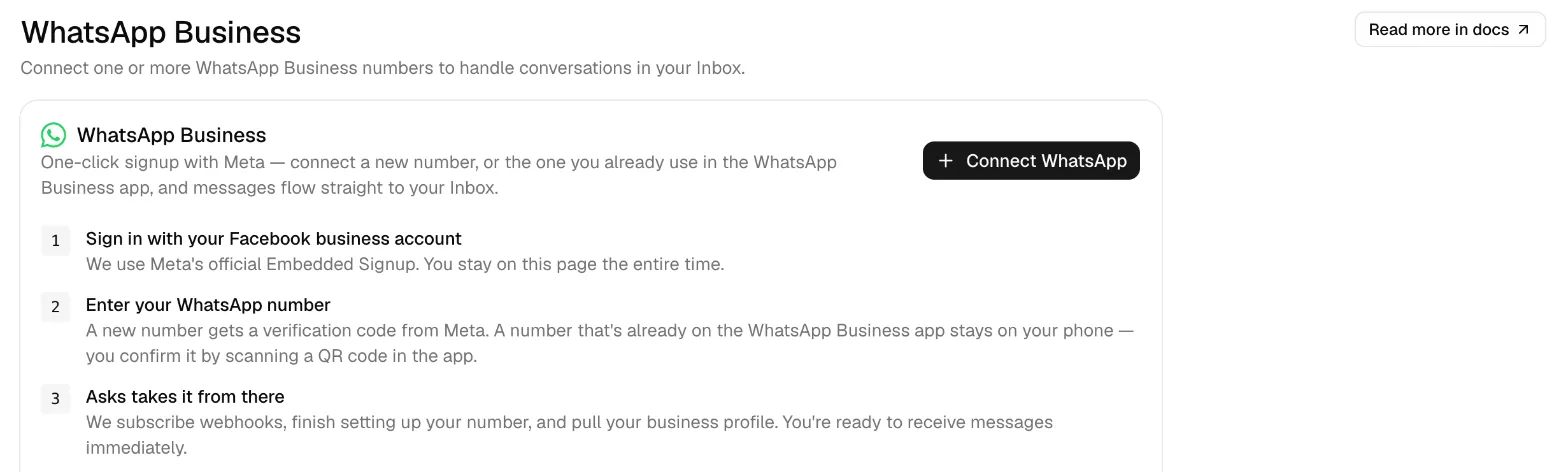
When the AI agent answers a WhatsApp customer, its replies are service messages, priced exactly like a teammate's reply and drawing on the same 1,000 free messages. Two things help keep that line small: the agent answers from your own content, so a question tends to take one reply instead of five, and conversations it can't resolve go to your team in the same shared inbox, in the same WhatsApp thread.
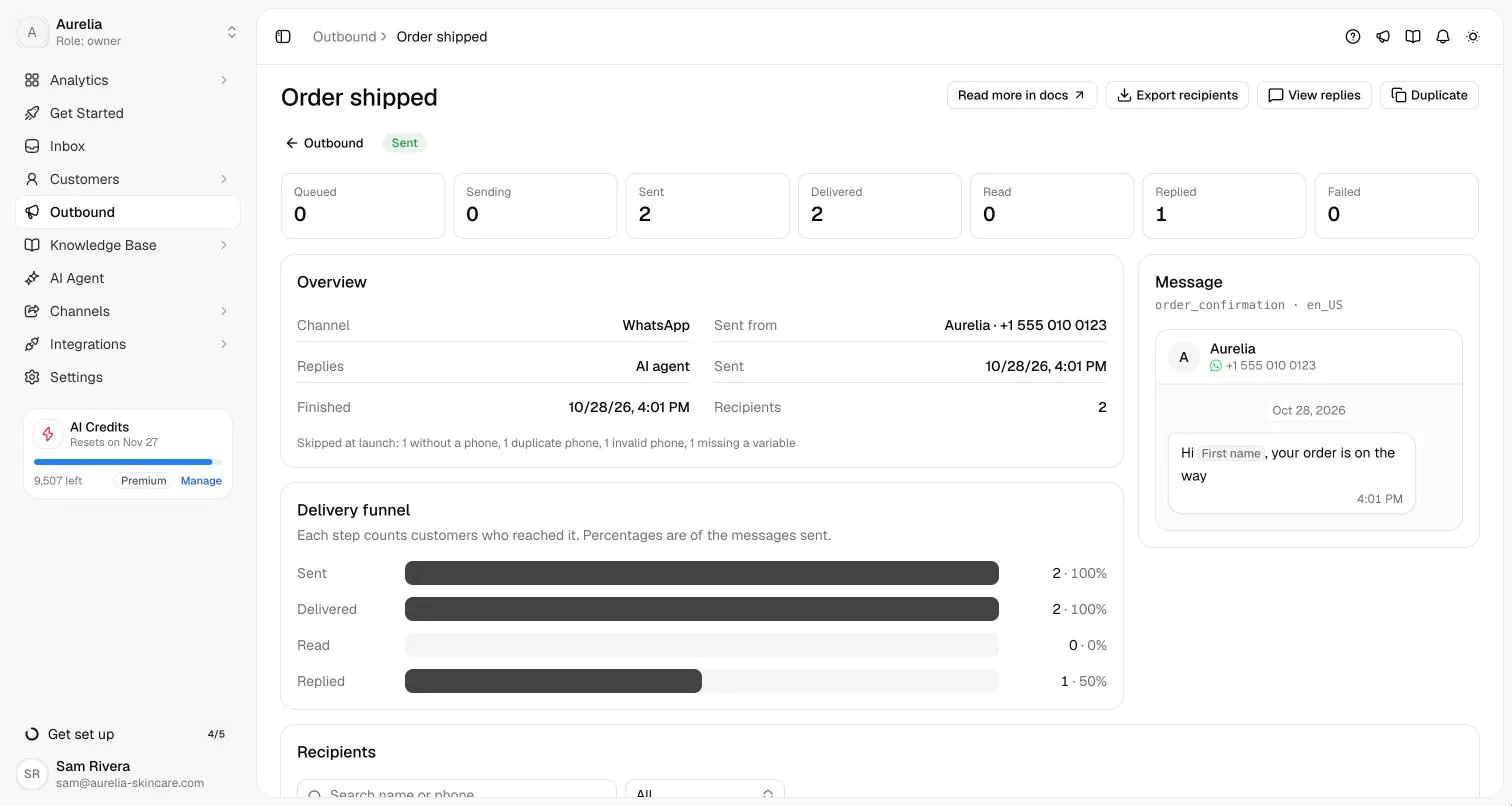
For outbound, Asks sends approved templates as WhatsApp campaigns and shows how many were delivered, which is what Meta bills:
More on the channel itself, including coexistence and templates, is on Asks for WhatsApp.
How to keep your WhatsApp bill down
- Resolve in the first reply. Above the allowance, every extra message in a conversation is billed. An answer that includes the tracking link, the policy and the next step costs one message instead of four.
- Categorize templates honestly, but don't default to marketing. "Your order has shipped" is utility. Filing transactional messages as marketing multiplies their cost by about 7 in the US and about 9 in Brazil.
- Cut marketing volume before support volume. In most markets one fewer campaign a month saves more than any support-side change.
- Use Click to WhatsApp ads where they make sense. Conversations that start from them open the free entry point window.
- Keep a payment method on file. Without one, Meta stops delivering service messages once the 1,000 are used, which looks to customers like you stopped answering.
- Watch volume tiers if you send many utility or authentication messages. The tier rates are in the volume tier file next to the rate card.
- Answer order-status questions before they become templates. If customers can ask "where is my order?" and get an answer from your store data, you send fewer proactive shipping updates. Our order tracking guide covers how.
Frequently asked questions
How much does the WhatsApp Business API cost?
Meta's part is per delivered message: in the US, $0.025 per marketing template and $0.0034 per utility, authentication or service message, with the first 1,000 service messages per number each month not charged (rates effective October 1, 2026). Meta's charges are per message, with no separate access fee, but you'll usually pay a platform as well.
Are replies to customers still free on WhatsApp?
Not past 1,000 a month. Since October 1, 2026, free-form replies inside the 24-hour window are service messages: each business phone number gets 1,000 free per month, and Meta charges from the 1,001st at the customer's country rate. Messages customers send you are never charged.
Does Meta charge for AI replies on WhatsApp?
It depends on whose AI writes them. Replies from a third-party AI, such as an AI support agent your platform runs, are service messages and cost the same as a person's reply. Replies from Meta Business Agent are billed per token at $2.00 per million tokens, about 4 to 5 cents per message by Meta's estimate, and the 1,000-message allowance doesn't apply to them.
Is the 1,000 free service messages per account or per phone number?
Per business phone number, per month. It resets at midnight in your Messaging account's time zone and doesn't roll over.
When does Meta change WhatsApp prices?
Only on the first day of a quarter (January 1, April 1, July 1 or October 1), with at least a month's notice for rate card changes. That's why this page carries an update date: we review it after each quarterly change.
What's the difference between the WhatsApp Business app and the API?
The WhatsApp Business app costs nothing and suits one person on one phone. The API (Cloud API) is what platforms connect to for shared inboxes, automation and AI agents, and it's billed per message as described here. With coexistence, a number can use both: you keep the app on your phone while a platform such as Asks handles the same number.
Sources
Checked 2026-11-16.
- Meta, WhatsApp Business Platform pricing (rules, categories, free tier, free entry point, Meta Business Agent, pricing calendar, currencies): developers.facebook.com/documentation/business-messaging/whatsapp/pricing
- Meta, USD list rates and volume tiers effective October 1, 2026: the rate card files linked from the "Rate cards and volume tiers" section of the page above
- Meta, pricing updates for Meta Business Agent, service and utility messages: developers.facebook.com/documentation/business-messaging/whatsapp/pricing/non-template-messages
- Meta, AI Providers pricing: developers.facebook.com/documentation/business-messaging/whatsapp/pricing/ai-providers
- Twilio WhatsApp pricing: twilio.com/en-us/whatsapp/pricing
- 360dialog pricing: 360dialog.com/pricing
- Asks WhatsApp channel documentation: docs.asks.app/channels/whatsapp
Ray is the pen name of the founder of Asks, who writes here about the economics of customer support and AI agents. How we write
Put an AI support agent on your site today
Asks trains on your website, docs, and help center — then resolves customer conversations on every channel, and hands off to your team when it matters.