Glossary · Support metrics
What is CSAT?
CSAT (customer satisfaction score) measures how satisfied customers were with one interaction, usually from a 1–5 rating asked right after a conversation ends. The common formula is positive ratings (4s and 5s) ÷ all ratings × 100, so 42 positive ratings out of 50 is a CSAT of 84%.
Also calledCustomer satisfaction score · CSAT score
By Ray, pen name of the Asks founderUpdated
Formula
CSAT = (ratings of 4 or 5 ÷ all ratings) × 100
Worked example: 50 customers rate a chat: 30 give 5 stars, 12 give 4, 5 give 3 and 3 give 1. CSAT = 42 ÷ 50 × 100 = 84%.
Some tools report the average instead (here 216 ÷ 50 = 4.3 out of 5). Both are called CSAT, so say which one you mean before comparing numbers.
How CSAT is collected
The survey is one question, "How would you rate this conversation?", on a 1–5 star or emoji scale, shown when the conversation closes. Some teams use thumbs up or down, in which case CSAT is simply the share of thumbs up. Keep it to one tap: every extra question lowers the number of people who answer.
Reading CSAT honestly
- Check the response rate first. A 4.8 average from 3% of customers says less than a 4.3 from 30%. Very unhappy and very happy customers answer more often than everyone in between.
- Split AI and human conversations. If AI-handled conversations score well below human ones, the AI is closing conversations it hasn't solved. Read CSAT next to AI resolution rate.
- Read the low ratings. A reason picker on 1–3 star ratings (wrong answer, too slow, needed a person) turns a score into a to-do list.
- Remember what it measures. CSAT rates one interaction. Loyalty to the brand is what NPS asks about; CSAT vs NPS compares the two.
What is a good CSAT score?
No single benchmark is worth quoting: scales, survey timing and who gets asked differ too much between companies. Track your own trend by channel and by topic, and look into any week that drops. Our customer service metrics guide shows where CSAT sits next to response time and resolution.
In the product
How Asks handles this
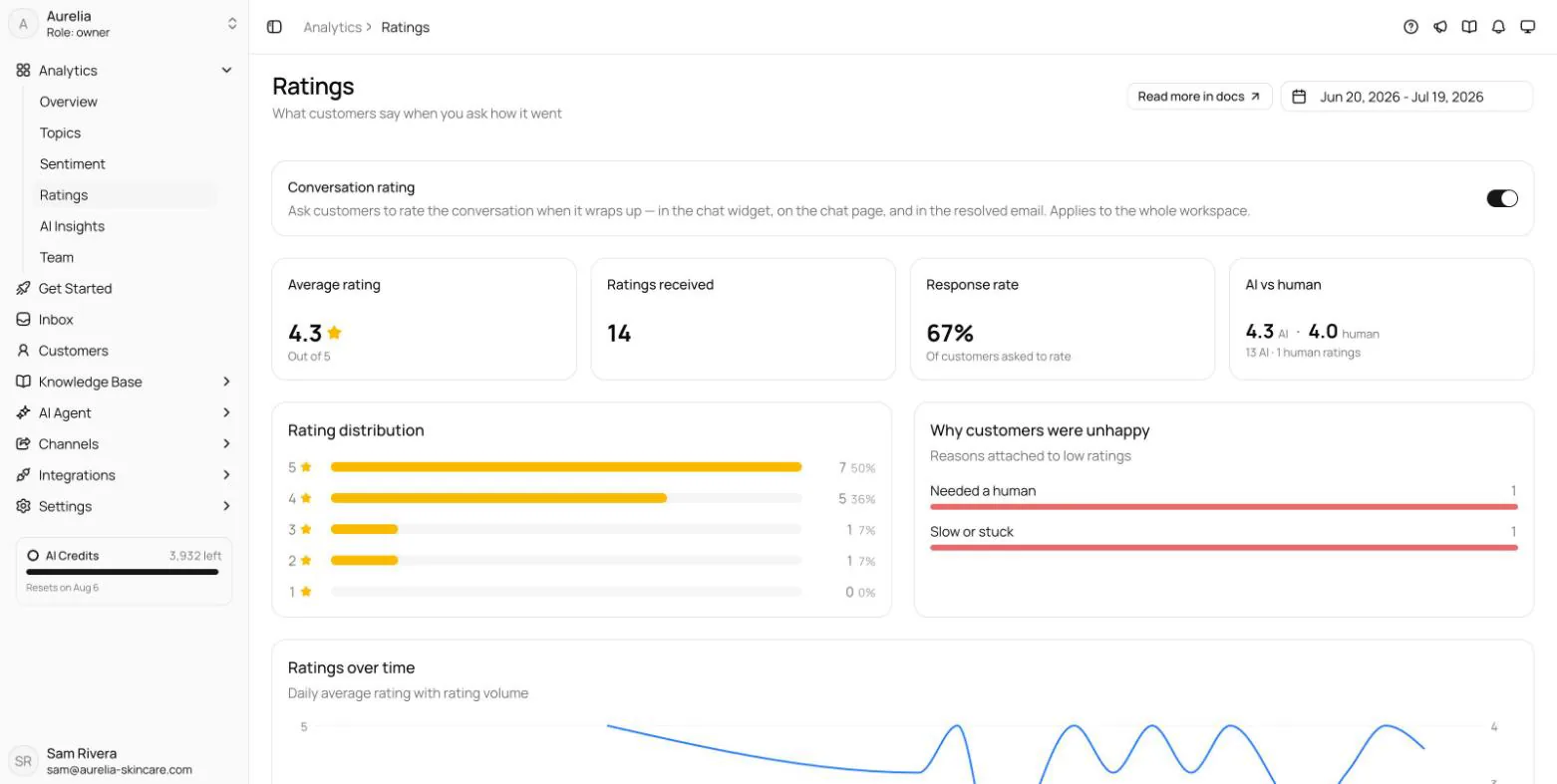
Asks asks customers to rate the conversation out of 5 as it wraps up: in the chat widget, on the Chat Page and through star links in the resolved email. The Ratings page shows the average, the response rate, AI vs human scores and the reasons behind low ratings, on every plan, and each rating also appears next to its conversation in the shared inbox. It's part of the AI help desk.
7-day free trial · card required · cancel anytime
FAQ
Questions, answered.
01What does CSAT stand for?
Customer satisfaction score. It's usually the share of customers who rated an interaction positively, meaning 4 or 5 on a 1–5 scale.
02How do you calculate CSAT?
Divide the number of positive ratings (4s and 5s on a 1–5 scale) by the total number of ratings and multiply by 100. 42 positive ratings out of 50 gives 84%.
03Is CSAT the same as NPS?
No. CSAT rates one interaction; NPS asks how likely someone is to recommend the company, on a 0–10 scale. Use CSAT to judge support conversations and NPS for the overall relationship.
Related terms
- CSAT vs NPSCSAT rates one interaction; NPS measures loyalty to the company. Which to use, and when.Support metrics
- Net Promoter Score (NPS)Loyalty on a 0–10 "would you recommend us?" scale: % promoters (9–10) minus % detractors (0–6).Support metrics
- Customer effort score (CES)How easy it was to get help, usually agreement with "they made it easy" on a 1–7 scale.Support metrics
- First contact resolution (FCR)The share of issues solved in the first conversation, with no repeat contact.Support metrics
- AI resolution rateThe share of conversations an AI agent resolves on its own; the definition of "resolved" decides it.Support metrics
How we made this page
Written by Ray (the pen name of the Asks founder) from how support teams use the term and how Asks implements it, with AI-assisted drafting. Formulas and examples are worked arithmetic, not benchmarks; every outside fact links to its source with the date we checked it, and product facts were checked against Asks on 2026-11-17. How we write and correct pages is in our editorial policy.
Sources
- Asks docs: Ratings & CSAT (checked Nov 17, 2026)

Answer customers instantly, hand the rest to your team.
Asks learns your website and help center, answers on chat, email and messaging apps, and hands conversations to your team in one inbox when a person should take over.
7-day free trial · card required · cancel anytime