Glossary · Support metrics
What is AI resolution rate?
AI resolution rate is the share of conversations an AI agent resolves on its own, with no person involved and no sign the customer still needed help. Formula: AI-resolved conversations ÷ conversations the AI handled × 100. If the AI handles 800 conversations and resolves 520, the rate is 65%.
Also calledAutomated resolution rate · Automation rate · AI automation rate
By Ray, pen name of the Asks founderUpdated
Formula
AI resolution rate = AI-resolved conversations ÷ conversations the AI handled × 100
Worked example: 800 conversations reach the AI agent: 520 end resolved, 230 are handed to the team and 50 end with no clear outcome. AI resolution rate = 520 ÷ 800 × 100 = 65%.
Confirmed vs assumed resolutions
The number depends on what counts as resolved. A confirmed resolution means the customer said the answer solved it. An assumed resolution means they simply didn't come back or ask for more. Assumed resolutions include customers who gave up, so a rate built mostly on silence looks better than reality.
Why the definition can decide your bill
Some vendors charge for every resolution, so their definition matters twice. As checked in November 2026, Fin (formerly Intercom) charges $0.99 per outcome and counts a resolution when "no further help is requested after Fin's last answer". Zendesk bills only verified automated resolutions, where extra signals confirm the outcome, while its reported rate also counts contained ones. Compare pricing models in the AI Support Pricing Index or with the AI support cost calculator.
Reading it well
- Pair it with CSAT on AI-handled conversations. A high rate with low ratings means the AI is closing conversations it didn't solve.
- Watch repeat contacts; they catch false resolutions (see first contact resolution).
- Break it down by topic. A low rate on one topic usually means a missing article in your knowledge base, not a weak model.
- Don't chase 100%. Refunds, complaints and upset customers belong with people.
In the product
How Asks handles this
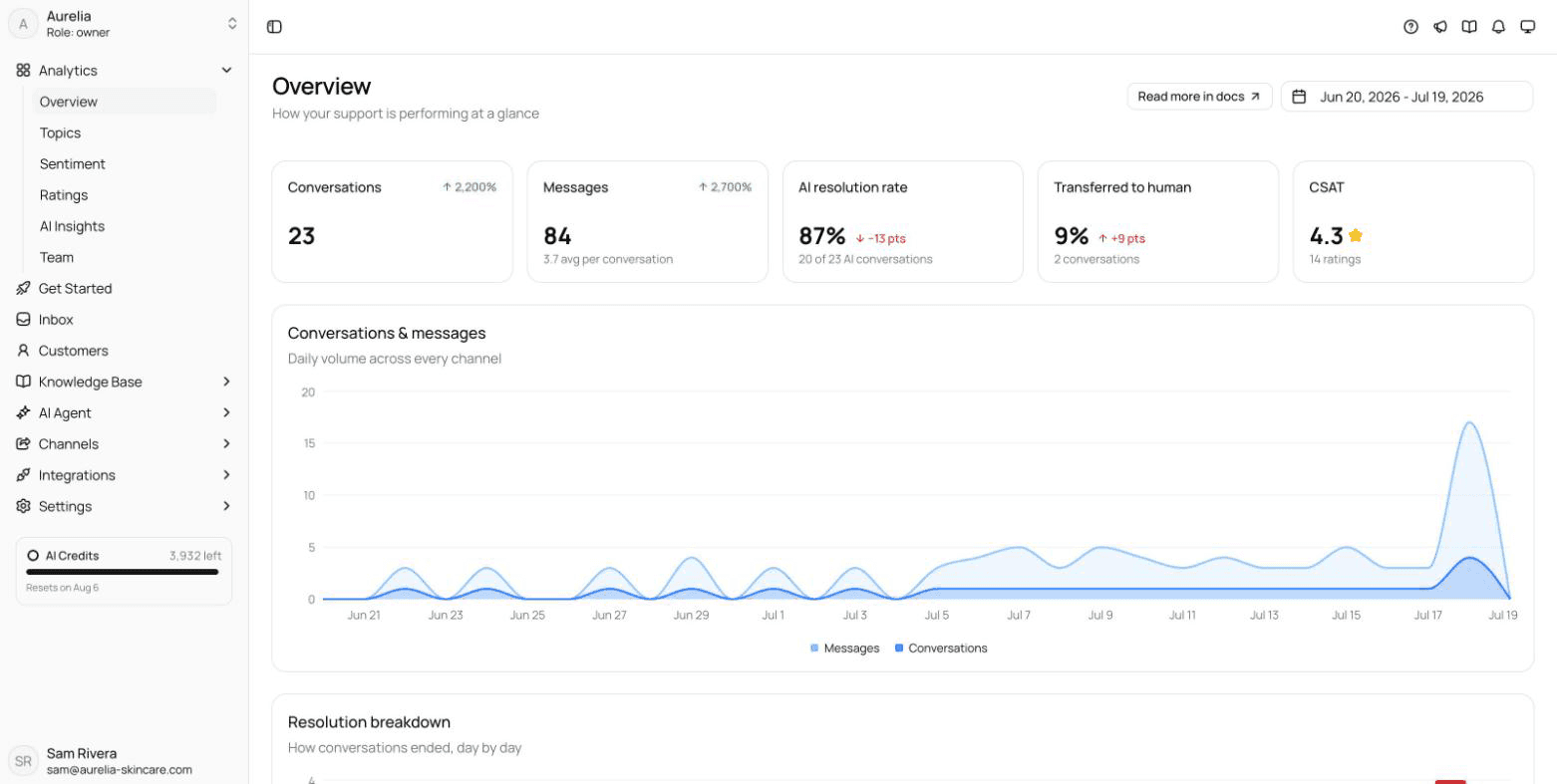
The Asks analytics overview shows the AI resolution rate (the share of conversations the AI took part in that it resolved on its own) with a breakdown into confirmed resolved, assumed resolved, small talk and unresolved, next to transfers to a human and CSAT. It's on every plan, and AI replies come out of the plan's monthly AI credits rather than a per-resolution fee. More in the AI help desk.
7-day free trial · card required · cancel anytime
FAQ
Questions, answered.
01What is a good AI resolution rate?
It depends on your question mix and documentation. Teams with mostly routine questions and a complete help center see higher rates than teams with account-specific or technical support. Measure it per topic and against CSAT rather than against a vendor's headline number.
02Is AI resolution rate the same as deflection rate?
No. Deflection counts questions that never became a ticket; a resolution rate should require evidence that the issue was solved. Some vendors use the terms loosely, so read the definition behind any number.
03Why do vendors report such different resolution rates?
Because they count different things: confirmed or assumed resolutions, which conversations are in the denominator, and how long a customer has to stay silent. Rates only compare when the definitions match.
Related terms
- Containment rateThe share of bot or AI conversations that never reach a human agent; not the same as resolved.Support metrics
- Deflection rateThe share of questions answered by self-service before they become tickets, and its blind spot.Support metrics
- CSAT (customer satisfaction score)How satisfied customers were with one interaction, usually the share of 4 and 5 ratings on a 1–5 scale.Support metrics
- First contact resolution (FCR)The share of issues solved in the first conversation, with no repeat contact.Support metrics
- AI agentSoftware that answers customers in natural language and takes actions to resolve their request.AI in support
How we made this page
Written by Ray (the pen name of the Asks founder) from how support teams use the term and how Asks implements it, with AI-assisted drafting. Formulas and examples are worked arithmetic, not benchmarks; every outside fact links to its source with the date we checked it, and product facts were checked against Asks on 2026-11-17. How we write and correct pages is in our editorial policy.
Sources
- Fin pricing: outcome definitions and price per outcome (checked Nov 17, 2026)
- Zendesk help center: Announcing changes to AI agent reporting (effective 18 May 2026) (checked Nov 17, 2026)
- Asks docs: Analytics overview (checked Nov 17, 2026)

Answer customers instantly, hand the rest to your team.
Asks learns your website and help center, answers on chat, email and messaging apps, and hands conversations to your team in one inbox when a person should take over.
7-day free trial · card required · cancel anytime