CSAT calculator
CSAT is the share of survey responses that are satisfied: satisfied responses ÷ total responses × 100. So 42 satisfied out of 50 is a CSAT of 84%, and with only 50 responses the true figure is likely between 71% and 92%. Enter your counts, or a 1–5 or 1–10 rating breakdown, to get yours.
By Ray, founder of Asks · Updated · Free, no sign-up · Runs in your browser
Calculator
Calculate your CSAT score
Pick what you have: satisfied and total responses, or how many customers gave each rating. The result updates as you type.
Result
84%
CSAT: 42 satisfied of 50 responses. With this many responses the true figure is likely between 71% and 92% (95% confidence, about ±13 points).
95% range
71%–92%
Wilson score interval
Not satisfied
16%
8 responses
Put this result in a report or post
How to
How to calculate CSAT in four steps
- 01
Ask one question, right after
“How satisfied were you with this conversation?” on a 1–5 scale, sent when the conversation ends, while it's fresh.
- 02
Count the satisfied responses
With top-2-box, every 4 and 5 (or 9 and 10 on a 10-point scale). Decide once and keep it.
- 03
Divide by all responses
Satisfied ÷ responses × 100. Customers who didn't answer aren't in the denominator; track them as response rate.
- 04
Read the margin, not just the number
With few responses the score swings. Check the 95% range before you celebrate or panic over a weekly change.
Method
The CSAT formula and the top-2-box rule
CSAT % = satisfied responses ÷ total responses × 100. What counts as satisfied depends on the scale, so write it down next to the number.
| Scale | Top-2-box (satisfied) | Stricter variant | Looser variant |
|---|---|---|---|
| 1–5 | 4 and 5 | 5 only (top box) | — |
| 1–10 | 9 and 10 | 10 only | 8 to 10 (top-3-box) |
- An average is not a CSAT %. Some tools report the mean rating. The breakdown in the screenshot below averages 4.3 out of 5, and its top-2-box CSAT is 86% (12 of 14). Both are useful; don't compare one with the other.
- The 95% range is the Wilson score interval for a proportion. It stays between 0% and 100% and behaves at small samples, where the textbook ±1.96 standard errors does not.
- Responses needed for a margin of about ±10, ±5 and ±3 points: 97, 385, 1,068 (95% confidence, worst case at 50%).
- Response bias is real: customers who had a very good or very bad experience answer more often. Pair CSAT with its response rate and with the reasons behind low scores.
Benchmarks
What counts as a good CSAT score?
No single number applies to everyone. Published benchmarks use different questions and scales, so read them as context, not a target.
- UK Customer Satisfaction Index (UKCSI): 78.3 out of 100 in the July 2026 edition, from the Institute of Customer Service (source, checked Nov 2026). It is an index built from more than 25 satisfaction measures across sectors, not a top-2-box percentage, so a CSAT of 80% is not “above” a UKCSI of 78.3.
- American Customer Satisfaction Index (ACSI): also a 0–100 index from its own multi-question model, published nationally and by industry on theacsi.com. Its pages didn't load for our check on Nov 17, 2026, so we don't quote a current score here.
- Vendor “average CSAT” figures come from that vendor's own customers and survey design. Treat them as anecdotes.
- The benchmark that holds up is your own: the trend over time, by channel, by topic, and for AI-handled versus human-handled conversations.
In Asks
Collect CSAT on every conversation
Asks asks customers to rate the conversation out of 5 as it wraps up, in the chat widget, on the Chat Page and through star links in the resolved email, on every plan. Low ratings ask why.
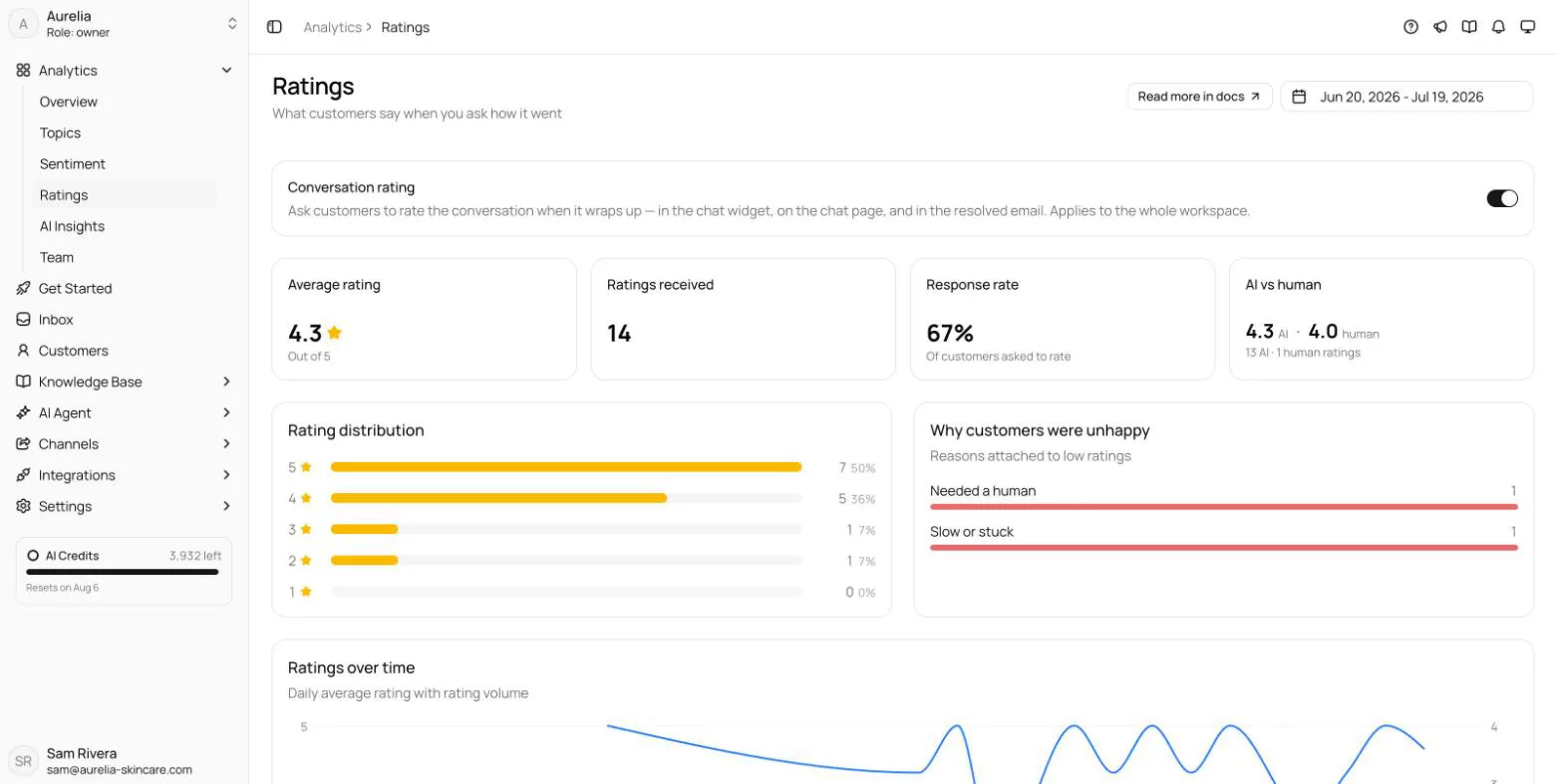

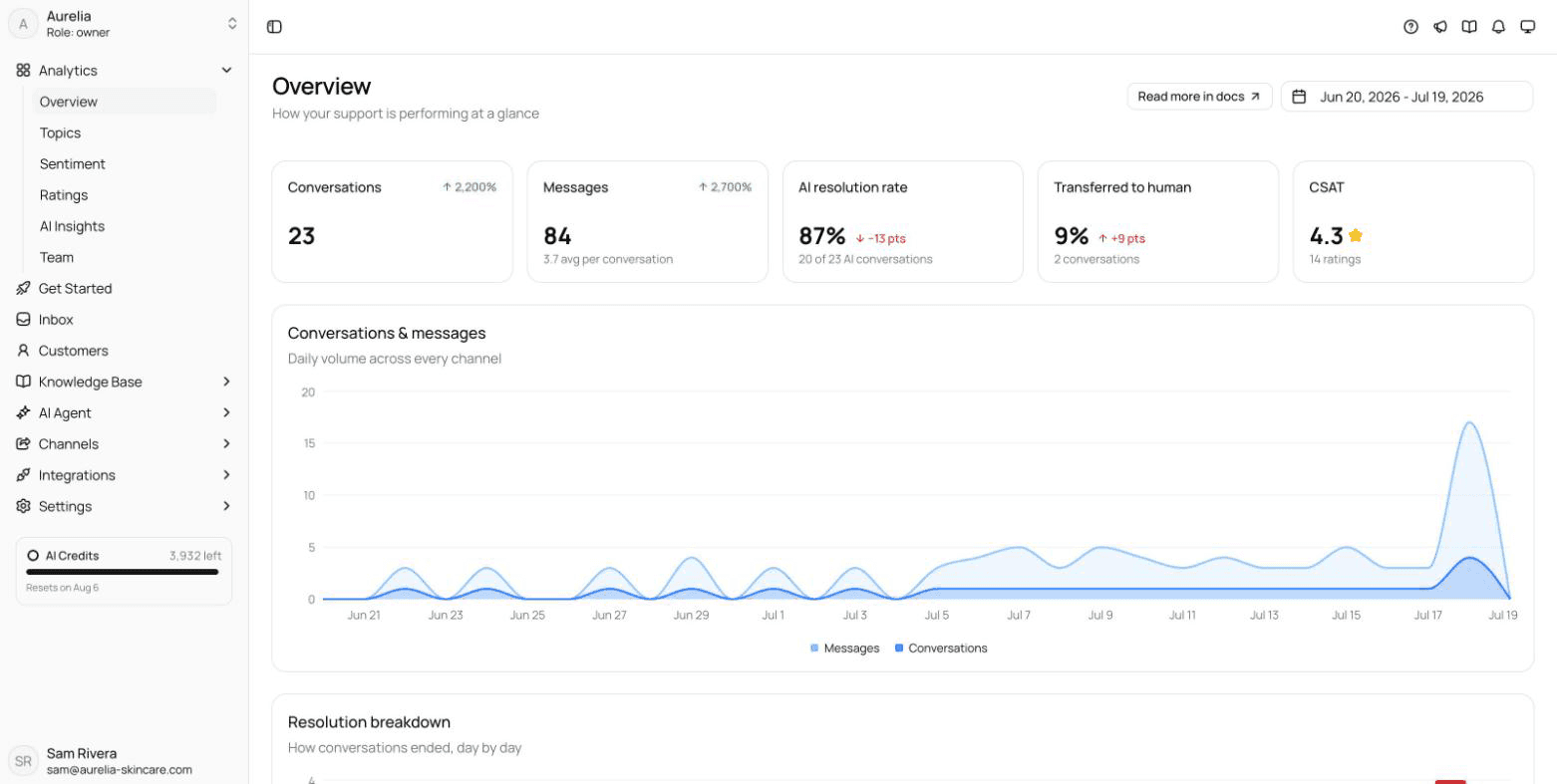
A 1 or 2 emails the conversation's assignee, and each rating links back to its conversation in the shared inbox, so a bad score leads to a fix, not just a chart. More in the Ratings & CSAT docs and the AI help desk overview.
FAQ
Questions, answered.
01How do you calculate CSAT?
Divide the number of satisfied responses by the total number of responses and multiply by 100. On a 1–5 scale, satisfied usually means a 4 or 5. 42 satisfied out of 50 responses is 84%. Divide by responses, not by customers you asked; that second ratio is your response rate.
02What does top-2-box mean?
It counts the two highest points of the scale as satisfied: 4 and 5 on a 1–5 scale, 9 and 10 on a 1–10 scale. Top box counts only the highest point. Say which one you use when you report CSAT; the same survey gives different numbers.
03What is a good CSAT score?
There is no universal benchmark: surveys differ in question, scale, timing and who answers. National indexes such as the UKCSI and the ACSI publish 0–100 index scores built from several questions, not top-2-box percentages (see benchmarks). Your own trend, split by channel and by AI versus human conversations, is the comparison that holds up.
04How many survey responses do I need for a reliable CSAT?
For a margin of about ±10 points, around 97 responses; ±5 points, about 385; ±3 points, about 1,068 (95% confidence, worst case). Below that, week-to-week swings are mostly noise.
05Is CSAT the same as NPS?
No. CSAT asks how satisfied a customer was with one interaction, right after it. NPS asks how likely they are to recommend the company, which measures the whole relationship. Our customer service metrics guide covers when each one fits.
06Should I measure CSAT separately for AI and human conversations?
Yes. A blended score hides whether an AI agent resolves questions or only deflects them. Report AI-handled and human-handled CSAT side by side, with each response rate; Asks's Ratings page shows the split.
07Does this calculator send my numbers anywhere?
No. The calculation runs in your browser; nothing you enter is sent to Asks or stored.
Sources
Sources and how we made this page
Written by Ray, the pen name of Asks's founder. The math is a plain proportion and the Wilson score interval, written out in the method section and run unchanged by the calculator. Benchmarks come only from the publishers' own pages, with the date we read them. The screenshots are from Asks's demo workspace. Asks sells a support product that collects CSAT; see our editorial policy.
- Institute of Customer Service, UK Customer Satisfaction Index (July 2026: 78.3 out of 100): www.instituteofcustomerservice.com/research-insight/ukcsi/ · checked Nov 17, 2026
- American Customer Satisfaction Index (ACSI) (0–100 scale; current scores on its site): theacsi.com/ · checked Nov 17, 2026
- E. B. Wilson (1927), Probable inference, the law of succession, and statistical inference, JASA 22(158) (the interval used for the 95% range): doi.org/10.1080/01621459.1927.10502953 · checked Nov 17, 2026
- Asks docs: Ratings & CSAT (how Asks collects and reports ratings): docs.asks.app/analytics/ratings · checked Nov 17, 2026
Ask every customer how it went
Asks answers your customers from your own content, hands off to your team when it should, and asks for a rating at the end of every conversation.
7-day free trial · card required · cancel anytime