Glossary · AI in support
What is an AI hallucination?
An AI hallucination is a confident answer from an AI model that is false or made up, such as a support chatbot promising a 60-day return window when your policy says 30 days. It happens because language models produce plausible text, not verified facts.
Also calledChatbot hallucination · LLM hallucination
By Ray, pen name of the Asks founderUpdated
Why it happens in support
- Missing content: the answer isn't in your knowledge base, so the model fills the gap from general knowledge.
- Conflicting content: two articles disagree, or an old policy is still published.
- Wrong retrieval: the system finds a similar but wrong passage, such as another product's warranty.
- Pressure to answer: instructions that never allow "I don't know" push the model to guess.
Why it matters
Customers treat a chatbot's answer as your company's answer. In February 2024, a British Columbia tribunal held Air Canada liable for a bereavement-fare policy its website chatbot had described incorrectly, and rejected the argument that the bot was responsible for its own statements (Moffatt v. Air Canada, 2024 BCCRT 149).
How to reduce it
- Answer only from approved content, using retrieval-augmented generation.
- Show sources, as a good AI chatbot for your website should, so customers and your team can check.
- Make "I don't know, let me get a person" an acceptable answer (escalation).
- Test before changes go live: run realistic questions against the agent and check the answers.
- Fix the content, not only the prompt. Most wrong answers trace back to a gap in the knowledge base.
Our guide to chatbot hallucinations covers each safeguard in depth.
In the product
How Asks handles this
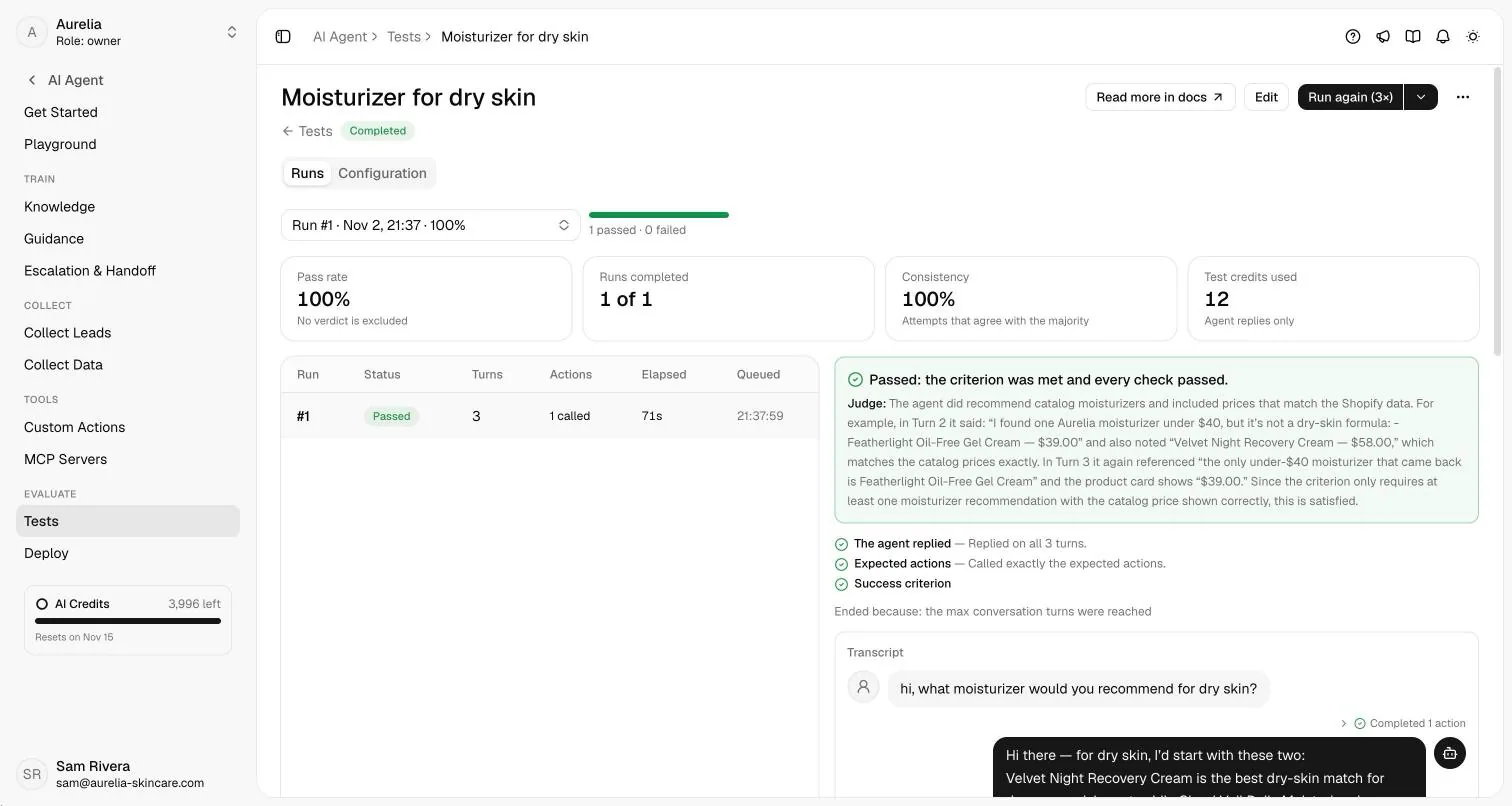
Asks answers from your own content, shows its sources in web chat, and hands off when it can't support an answer or the customer asks for a person. AI Tests run simulated customer conversations against the agent before you ship a change, with a judge scoring each reply against your expectations. See how it works.
7-day free trial · card required · cancel anytime
FAQ
Questions, answered.
01Can AI hallucinations be prevented completely?
No, but they can be made rare and caught early: answer from approved content, let the AI say it doesn't know, show sources, test before shipping, and review conversations with low ratings.
02Who is responsible when a chatbot gives a wrong answer?
In the cases decided so far, the business that runs it. In Moffatt v. Air Canada (2024), the tribunal held the airline responsible for what its chatbot told a customer. Treat every bot answer as a statement from your company.
Related terms
- Retrieval-augmented generation (RAG)An AI first retrieves relevant passages from your content, then writes its answer from them.AI in support
- Knowledge baseAn organized library of help articles, policies and FAQs used by customers, agents and AI.AI in support
- AI agentSoftware that answers customers in natural language and takes actions to resolve their request.AI in support
- Escalation (human handoff)Moving a conversation to someone better placed to solve it, including AI-to-human handoff.Inbox and operations
- AI resolution rateThe share of conversations an AI agent resolves on its own; the definition of "resolved" decides it.Support metrics
How we made this page
Written by Ray (the pen name of the Asks founder) from how support teams use the term and how Asks implements it, with AI-assisted drafting. Formulas and examples are worked arithmetic, not benchmarks; every outside fact links to its source with the date we checked it, and product facts were checked against Asks on 2026-11-17. How we write and correct pages is in our editorial policy.
Sources

Answer customers instantly, hand the rest to your team.
Asks learns your website and help center, answers on chat, email and messaging apps, and hands conversations to your team in one inbox when a person should take over.
7-day free trial · card required · cancel anytime